Friday, 1 April 2011

NOW AVAILABLE ON AMAZON.CO.UK AND WHSMITH and TESCO.COM

WALK THE WILD ROAD is now available at Amazon.co.uk. Here is the link:
http://www.amazon.co.uk/Walk-Wild-Road-Nigel-Hinton/dp/1402243774

It is also at WH Smith:

http://www.whsmith.co.uk/CatalogAndSearch/ProductDetails.aspx?productID=9781402243776

And at Tesco.com:

http://www.tesco.com/books/product.aspx?R=9781402243776&bci=4294937775%7CNigel%20Hinton

THE END OF THE ROAD

At last I came to Gdansk (known as Danzig in 1870, at the time of my story). Recent history, during the 1970s and 1980s, had seen it as the centre of the Solidarity movement  (Solidarność) which, with Lech Walesa at its head, had been the force that eventually led to Poland becoming a post-communist state. But I was looking for details of life in this Baltic port a hundred years before that, when my young hero, Leo, and his friend Tomasz were heading there, dreaming of catching a boat to the USA.

I walked the rivers and tributaries down which the boats would have sailed with their cargoes of grain and timber and amber. I strolled along the docks, imagining the boys filled with hope, and driven to find a boat across the Atlantic.

Scenes of the docks in Danzig as
Leo would have seen them in 1870.
Note the rafts of logs, like the ones
the two boys rode down the Vistula.


Then, on my last day in Gdansk, I walked up the hill to the old Napoleonic fort and looked down at the railway station and the distant spires and cranes and buildings. It is covered with grass and crumbling now but in 1870, with the Franco-Prussian War being waged, it must have been bustling with activity. As I wandered round an idea began to form in my mind of a tragic scene that Leo witnesses near the end of the book.


And then my journey was at an end. I had visited all the places that my Grandfather must have seen if, as I believed, he had made this journey from his tiny village, Wilhelmsdorf, along the Bromberg Canal to Bromberg and then down the Vistula to Danzig. I had made the journey, thinking of him, and yet imagining another boy making that journey. Leo. He had become real to me, this brave boy facing dangers and carrying on when all must have seemed hopeless. And his companions, too - his friendTomasz and their dog, Bel - were alive in my mind. I loved them.

Now I had to return to England and my desk. Now I had to find the right words which would make my readers share that journey. The words which would make them Walk The Wild Road in step with my young hero. And if I could do it right, I felt I would be honouring my Grandfather who had walked that road when he was no more than a little boy all those years ago.


Thursday, 31 March 2011

The Road Towards the Sea

I made my way slowly down the River Wisła (Vistula) – walking along the banks as often as I could, imagining Leo and Tomasz seeing these sights as their stray dog, Bel, scampered ahead of them.

I passed Graudenz, now known as Grudziadz. Perhaps, I thought, the boys could look for work in the town - maybe at the granaries on the small dock where boats and barges brought the wheat and took away the flour.


The old granaries and the skyline of Grudziadz
from the bank of the Wisła


Then I journeyed on, past Neuenburg (Nowe) to Mewe (Gniew) with its crumbling old walls and spectacular castle built by King Jan 111 Sobieski for his beautiful French wife, Marie Casimire Louise de La Grange d’Arquien, popularly known in Poland as Marysienka.

King Jan 111 Sobieski


Marysienka

The castle is now transformed into an hotel where I stayed the night.


Further downstream I came to Dirschau, now known as Tczew.


 It has two mighty bridges spanning the River Wisła. The first one, completed in 1857, had amazing castle-like turrets and I knew I would have to refer to it in my story.


While in Tczew I visited the Vistula River Museum housed in a grim looking old factory building.


Despite the unpromising exterior, the exhibits inside were fascinating and some photographs and one model entirely changed my ideas about Leo and Tomasz’s journey down the river. I learned that, at that time, it was common practice to float Galician pine trunks, bound together in long rafts, from the forests in the south of the country all the way down to the port of Danzig where the timber was shipped abroad. These 'rafts', often comprised as many as 15 'floats', each float consisting of 24 tree trunks. Men lived and worked on these rafts as they made their way down the river, negotiating dangerous obstacles such as sandbanks and rapids. Suddenly, I could see the possibility of adventures, and perhaps accidents, for the two boys afloat on the mighty river.

The river grew wider below Tczew and soon there were so many small streams and tributaries flowing into it that it was difficult to keep moving along parallel to the main stream. Then, eventually, there was  a salty tang to the air and glimpses of a broad stretch of water ahead – the river was meeting the sea.


I made my way through a pine forest and a huge sand dune and there was the Baltic Sea.

Sunday, 20 March 2011

DOWN THE ROAD APIECE


I made my way up to Torun, known as Thorn in 1870 and spent a couple of days looking round there, making notes for the story. Then I started down the River Wisła.


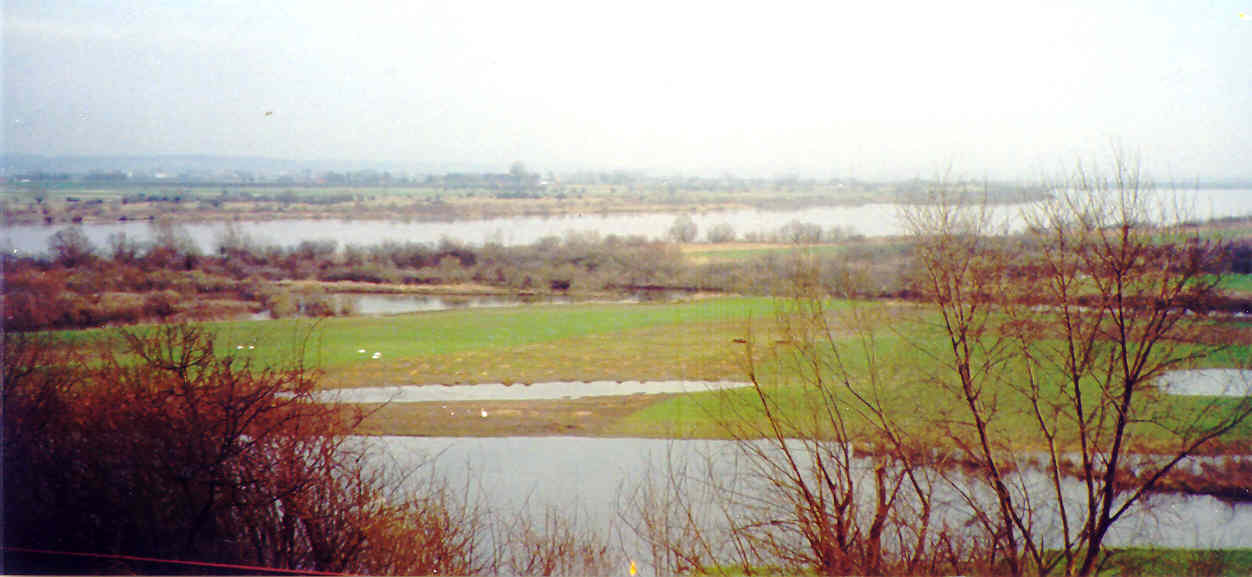
After all the rain, the river was running high and there were signs of flooding in low lying fields.


All these signs of flooding, and the fast-running river began to give me good background for Leo and Tomasz’s walk towards the sea and, after a time, a crucial part of the plot began to form in my mind.

Then, when I was walking along the riverbank one day, a dog began following me. She was a lovely creature and was obviously pleased to have someone to walk with. She stayed with me for a couple of hours until I retraced my steps to the car and, for all the world, seemed ready to jump in beside me. I wondered if she was lost or a stray and, as I drove away, I realised that I had a companion for Leo and Tomasz on their journey down the river.


Tuesday, 1 March 2011

BYDGOSZCZ STREETS

I liked Bydgoszcz. I loved walking the streets thinking about my two boys, Leo and Tomasz. Perhaps they would run down cobbled streets of Bromberg, as it was then known, to avoid trouble - or get out of it.


I thought of the dangers they would face, alone on the streets - poor, perhaps barefoot.


I imagined them in the marketplace. Perhaps cadging food, or begging, or even having to resort to stealing to keep themselves alive.


I pictured them dodging and out of the crowds assembled in the streets, perhaps to watch the soldiers marching to the station to catch trains towards the French front in readiness for the impending war.


And all the time they would be thinking of ways of getting away from the town and down to Danzig (Gdansk) to the sea - that immense stretch of water that they could only imagine, never having seen it. Down to the sea and then away to a new land. And I thought of ways for them to travel - perhaps they could get on a barge on the river Brahe and then onto the River Vistula.


I began to think about Tomasz's back story. Why was he on the streets alone? Where had he come from? What was he running away from? And that marvellous, inexplicable process of inspiration/invention/ creation began. Little details flitted into my mind - the son of a cobbler perhaps? And has learned the trade. Could he get work for them both? Or perhaps, he thinks he is the cobbler's son but he isn't really?

I began to feel the energy and drive of the boy. Something irrepressible. A huge sense of fun and optimism in the face of the adversity he has faced. He started to live in my head as I walked round the town and I began to love him and what he would give to Leo. Was this him, cheeky and full of mischief, attempting some scam to raise money to buy food for them both?


It was raining heavily the morning I left Bydgoszcz. And it was the morning of the Pope's funeral. The streets were totally empty, everybody inside watching the ceremony on TV. Their beloved Karol Józef Wojtyła who had represented them and brought honour to the nation as John Paul 2 (Jan Pawel Dwa), was being buried and they all wanted to watch.

The rain fell as I drove along the wet, empty streets out of Bydgoszcz. I saw one other car - a Police car, whose occupants stared at me suspiciously wondering why I wasn't inside watching tv with all the other decent people.

I was heading the few miles to Fordon. To the Vistula. To the river. Because despite having considered them getting a ride on a cart, or hiding on a barge, and despite the fact that I knew they would attempt to get on board a train with disastrous results, I had decided that my boys were going to make their way by foot down the river towards the sea.

I had my steamy heated car to keep me from the elements. No such comfort for them. And the river looked wide and the banks difficult walking under the grey, glowering skies.